Actualités Asociación Ibérica de Librerias Anticuarias Livraria Cólofon
"A sense of belonging to a community of booksellers"
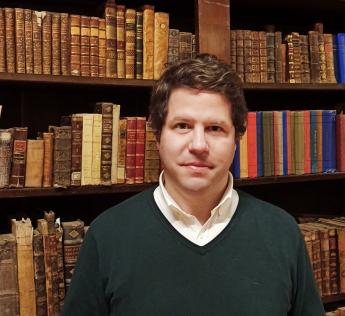
Francisco Brito recently joined the Spanish Antiquarian Booksellers Association and, therefore, our ILAB community. We spoke to Francisco about his business, the book trade in Portgul and what motivated him to join our network.
What do you deal in? Do you specialize?
I can’t say that I have any particular area of specialisation. However, recently I have been trying to focus on the Age of Exploration (some of the pioneering works from that period are Portuguese). In addition, from an early stage, I dealt in books and pamphlets relating to Brazil and the wider Portuguese-speaking world, Portuguese Civil War, as well as in rare pamphlets on a wide range of subjects. I also trade in first editions of both classic and contemporary literature. Even so, for the time being, most of my inventory is fairly general.
I am also always available to respond to requests from collectors or institutions and, in that sense, I end up dealing with a extensive range of subjects.
What motivated you to join your national association and ILAB?
A sense of belonging to a community of booksellers was one of the main factors. Although this profession allows us to meet many people, it can also be somewhat solitary, as I mostly work on my own. That’s why it’s good to feel connected to something and to fellow colleagues. In addition, the information I receive through ILAB and the possibility, in the future, of exhibiting at one of the association’s book fairs opens up new prospects for a bookseller like me. Being part of an association such as AILA and ILAB is also a great honour for me and a responsibility that I hope to live up to.
Regarding my admission to AILA/ILAB I must express my gratitude to Alicia Bardón (an incredibly kind person, who supported me from the very beginning) and to my colleague and friend Herculano Ferreira (who also endorsed my application to join the association).
How do you see the rare book trade evolving in your region?
The rare book trade in Portugal is evolving positively, but significant work still lies ahead.
Portugal is a country with an extraordinarily rich history and culture that extends far beyond its borders, reaching across the Portuguese-speaking world. There is, therefore a great deal to discover, promote, and explore when it comes to the bibliography that preserves our cultural heritage. This suggests that there is still significant scope for development in this área, which is good. To some extent, in this field, Portugal remains a diamond in the rough when compared to other countries. There is also a solid tradition in the rare book market and among antiquarian booksellers. Records show that booksellers’ and auctioneers’ catalogues were already being published in the eighteenth century, and throughout the nineteenth and early twentieth centuries, the market became increasingly vibrant. By that time, connections between Portuguese and foreign booksellers, bibliophiles, and institutions were well established. This shows that Portuguese bibliography is well known abroad and that interest in the Portuguese rare book market has long extended beyond national borders.
On the other hand, I believe there is still much to be done in the rare book trade in Portugal. The market is relatively small and institutional representation is limited, giving rise to a number of structural challenges. Only recently have we seen the return of antiquarian book fairs (which ceased to take place in the 1990s and returned only two years ago with the Salão do Livro Antigo de Coimbra, organized by the antiquarian bookseller Miguel de Carvalho). That was one of the most important developments in the Portuguese rare book trade as a sector over the last couple of decades. As is widely recognised, such fairs are indicative of a vibrant market, since although technology has replaced many aspects of the business, personal contact remains fundamental to the rare book trade. So, the antiquarian booksellers in Portugal must avoid ups and downs and ensure that this vitality remains constant.
However, Portugal has excellent booksellers and outstanding professionals connected to the book world, as well as good collectors and important private libraries. Therefore, despite some challenges, I believe that in the near future the outlook will be positive.
Buying and selling rare books is more than just a job, it is often a passion and a lifestyle. What do you love most about your work?
Without a doubt. It is a passion and a way of life, one that gives us independence and offers constant learning. The sadly missed Richard C. Ramer once said (quoting a friend) that this profession was “the last of the liberal arts”. In a way, I think he was right. In the world of books — especially rare books — our lives become a continuous process of learning across many different fields. Through contact with such varied areas, we end up meeting very different people whom we might otherwise never have encountered. Bookselling is one of the few businesses within the Humanities. And with every small gesture in the course of the trade, we take part in safeguarding memory, culture, and heritage, which is truly extraordinary.
I also love visiting private libraries or travelling around the country in search of books. This part is particularly enjoyable and exciting, because one week I might be looking for books in a second-hand shop, and the next visiting the library of a manor house or that of a major collector. Moreover, in this search, there is the pleasure of discovery — of finding a good opportunity, something unusual, or a book I have never heard of before, which then compels me to research and study it.
This combination of learning, the human side of the trade, and the constant search (perhaps even more than the discovery itself) for rare books makes this work a pleasure. These are the three aspects of the profession I am most passionate about.
To contact Francisco Brito, see his details >> HERE