Actualités
New York Book Fair Week: The Grolier Club Explores Ireland’s Literary Awakening
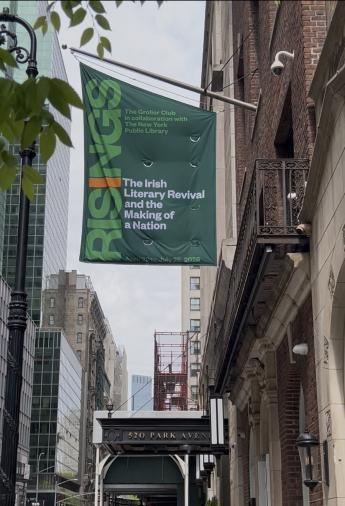
Just a short walk from the Park Avenue Armory, where the fair is held, stands one of the great institutions of the rare book world: The Grolier Club. Founded in New York in 1884, the Club is America’s oldest and largest society for bibliophiles and enthusiasts in the graphic arts. Named after the Renaissance collector Jean Grolier, it was established with the aim of fostering “the study, collecting, and appreciation of books and works on paper.”
From its beginnings, when a small group of New York collectors gathered to champion the art of printing and bookmaking, the Club has grown into an international fellowship of nearly 800 members, including collectors, antiquarian booksellers, librarians, designers, printers, binders, and scholars.
Today, located in the heart of Manhattan between Park Avenue and Fifth Avenue, it remains one of the most important organisations dedicated to cherishing and advancing the world of rare books. Through its renowned exhibition programme, publications, lectures, and its remarkable research library, particularly rich in booksellers’ and auction catalogues, it continues to shape scholarship and collecting alike.
Its exhibitions, often curated by its members, are consistently among the highlights of New York Book Fair Week, ranging across the full breadth of the rare book trade. For many visitors, a visit to the Grolier Club is as essential as the fair itself.
This year, the Club presents:
“Risings: The Irish Literary Revival and the Making of a Nation”
(April 29 – July 25, 2026)
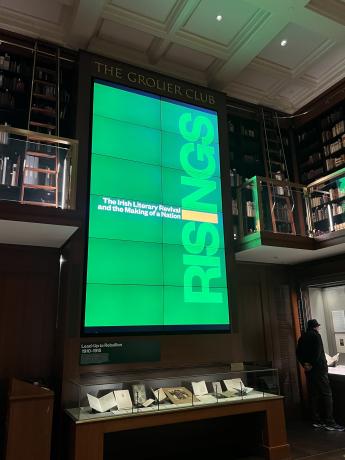
We visited the exhibition on opening day.
Risings explores the formation of Irish identity through the Irish Literary Revival of the late 19th and early 20th centuries, alongside the parallel political developments that led to Irish nationhood. The exhibition is presented in collaboration with The New York Public Library and includes newly identified material from its collections.
Curated by Grolier members Alexander Neubauer and Alan Klein, the exhibition brings together around 150 objects from their own collections. More than 30 items come from the renowned Henry W. and Albert A. Berg Collection of English and American Literature, now held at the New York Public Library.
True to its reputation of only exhibiting highest quality material and scholarship, we find a remarkable range of material on display: Rare books, but also manuscripts, letters, theatre pamphlets, political propaganda and photographs. The objects give a vivid impression of a period in which literature, politics and national identity were closely intertwined.
Rather than focusing only on well-known literary works, the exhibition also shows the broader printed culture of the time: ephemera, pamphlets and documents that reflect the political unrest and intellectual energy of the period. In this way, it offers a very complete picture of how ideas circulated and how literature contributed to shaping a nation.
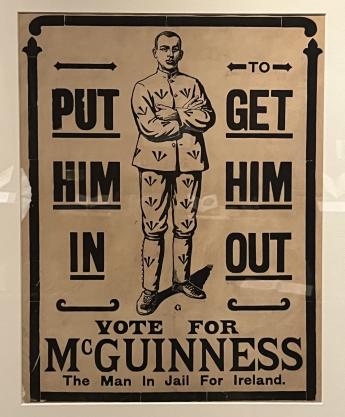
Quoting from the exhibition:
“By the turn of the twentieth century, the people of Ireland had already endured centuries of struggle for political independence and national identity. The American and French Revolutions had sparked national movements across Europe and elsewhere, but in the case of Ireland, the Irish rebellions of 1798 and 1848 against Britain both failed. Famine and exodus in the 1840s and ’50s eventually halved the population of the country, and, in the words of Gavin Duffy at the time, ‘paralyzed many forces in Ireland, and none more disastrously than our growing literature.’ Charles Stewart Parnell’s push for Home Rule in 1889 slipped away owing to the fallout from his adultery scandal. Yet while outright freedom from Britain seemed impossible to achieve, a cultural movement known as the Irish Literary Revival came to serve as a crucial impetus for Ireland’s reemergent sense of self, while establishing Ireland as a world-wide literary force.
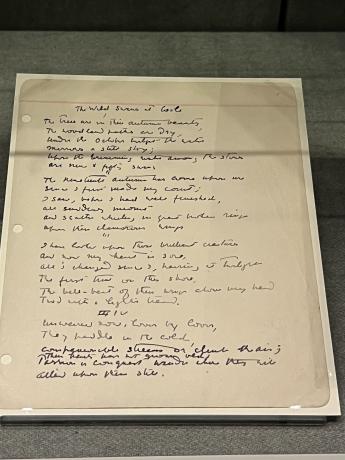
W. B. Yeats and Lady Gregory were among the founders of the movement that helped restore the native traditions of Ireland. By searching out the folklore, legend, music, and poetry of an ancient language and culture, often in collaboration, they re-animated the traditional stories that became the cornerstone of the Literary Revival. Both Dublin and Coole Park, Lady Gregory’s home in the west of the country, became central meeting grounds for the group of writers who created the novels, plays, and poems that galvanized the world. In short order, Yeats and Lady Gregory founded and directed a national theater that brought to the stage Irish plays with Irish actors, the first modern repertory company in the English-speaking world. And, together with other Irish writers, poets, and playwrights including J. M. Synge and Sean O’Casey, they succeeded in writing, in Lady Gregory’s phrase, ‘the book of the people.’
As the cultural identity of the country flourished, so did the push for political freedom, resulting in a burst of bloodshed in Dublin known as the 1916 Easter Rising. Britain’s summary executions of the rebel leaders drew international condemnation and energized a desire for independence even among the most moderate Irish residents. Six years after the 1916 Rising, following a violent struggle, Ireland achieved its independence. As for the Irish Literary Revival, it influenced movements around the world and spawned a further generation of Irish writers, from James Joyce and Flann O’Brien to Edna O’Brien and Seamus Heaney.”
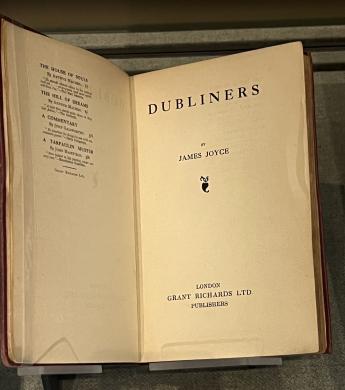
In 1904 George Russell (Æ) published the first three of James Joyce’s now classic stories in his weekly journal, The Irish Homestead. It was the year of Joyce’s departure from Ireland, and against the backdrop of rising nationalism and insularity, Joyce sought to present “a nicely polished looking-glass” to Dublin, ripe with the theme of paralysis. While in Rome and recalling Ireland’s abiding sense of hospitality, he finished his final, most famous story, “The Dead.” This copy of Dubliners belonged to Forrest Reid, whose novel Following Darkness influenced Joyce’s A Portrait of the Artist as a Young Man. Reid also wrote the first book-length work of criticism on W. B. Yeats.
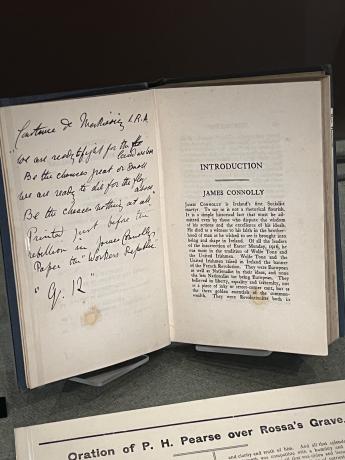
Among the seven signatories of the Irish Proclamation of 1916, James Connolly initially worked more for the cause of worker’s rights and socialist ideals than for Irish nationhood. “Ireland, as distinct from her people, is nothing to me,” he wrote in this influential book, first printed in 1910. A leader in the 1913 Dublin Lockout, who helped form the Irish Citizen Army, he was also an avowed feminist and mentor to rebel leader Constance Markievicz, who inscribed this book. His execution in May of 1916 following the Easter Rising, tied to a chair because of his wounds suffered during the fighting, turned public sentiment against the British and made martyrs of the rebels.
The exhibition offers a striking perspective on how closely literature and politics can be intertwined. Through books, manuscripts, letters and ephemera, these connections become relatable and should be a highlight for any collector or book enthusiast.
It is a fitting and inspiring opening to New York Book Week, one that sets the tone for the days ahead: the largest rare book fair in the world and a rich programme of events.
--> Grolier Club "Risings: The Irish Literary Revival and the Making of a Nation"